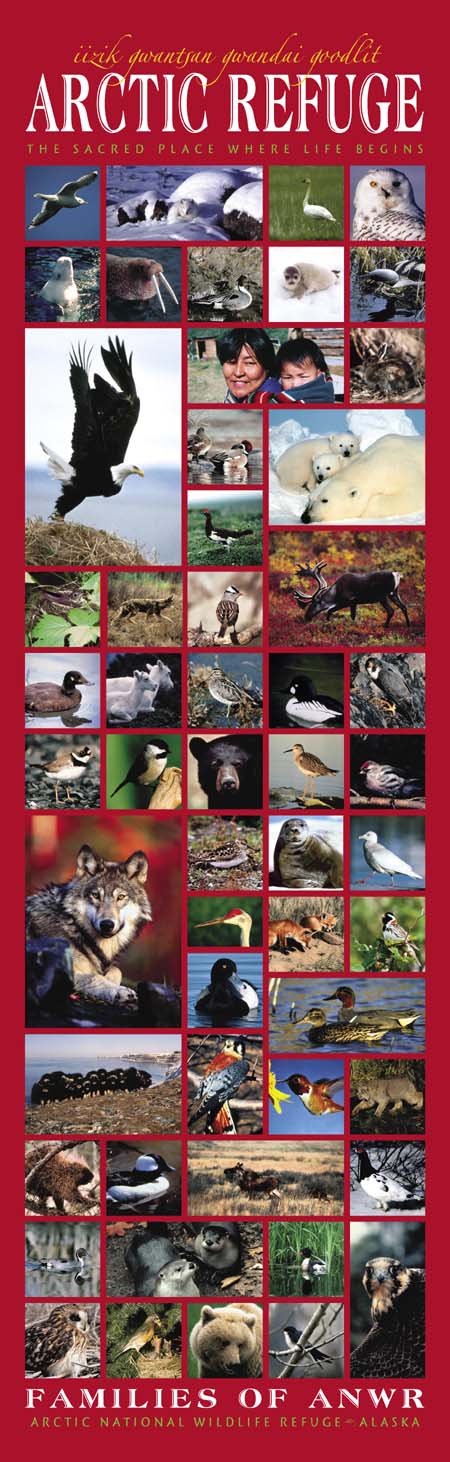
ARCTIC NATIONAL WILDLIFE REFUGE
Iizik Gwantsan Gwandai Goodlit: The Sacred Place Where Life Begins
THIS POSTER IS CURRENTLY OUT-OF-STOCK.
A Project to Benefit the Gwich'in Peoples in the Protection
of their Way of Life and the Refuge Wildlife
Click HERE to view a full-size PDF of the descriptive text on the back of the poster
SPECIAL THANKS goes to the US Fish and Wildlife Service, Dick Bancroft, International Crane Foundation, National Oceanic and Atmospheric Administation (NOAA) and Alaska Fish and Game for their assistance in providing images and information for this poster, as well as to Luci Beach and Sarah James of the Gwich'in Steering Committee. The design and printing of the poster have been donated by PANGAEA for educational purposes.
SIZE 9 inches x 29.5 inches
FULL TEXT of poster
In the far northeast corner of Alaska lies the biological heart of the Arctic National Wildlife Refuge (ANWR). This is one of the most magnificent breeding grounds in the world. Approximately 40,000 porcupine caribou herd calves are born and/or nurse here in the early part of June each year. Birds from all 50 states and four continents migrate to the refuge for nesting and staging. It is the most important denning area on land for polar bears in the United States.
ANWR is one of the largest refuges within the US National Wildlife Refuge System. It is managed by the US Fish and Wildlife Service, Department of the Interior. The 19.6-million-acre refuge is among the most complete and undisturbed ecosystems left on Earth. Here, coastal lagoons, barrier islands, arctic tundra, foothills, mountains, and boreal forests provide a combination of habitats, climate, and geography unmatched by any other northern conservation area�conditions that support the refuge�s diverse community of life.
Dominated by the mountainous Brooks Range, the refuge is the domain of caribou, wolves, musk oxen, wolverines, snow geese, and other wilderness-dependent species. The rich pageantry of wildlife species within the refuge includes more than 160 bird, 45 land and marine mammal, and 36 fish.
The Gwich�in Traditions and Culture
The Gwich�in are a nation of native Athabascan peoples who have lived a traditional subsistence
way of life on these same lands for over 20,000 years. Their ancestors lived as nomadic hunters and
gatherers. More than 7,000 Gwich�in live in 15 villages on their prehistoric homelands in northeast
Alaska and northwest Canada, above the Arctic Circle. Their way of life remains among the most
traditional of the surviving North American cultures. 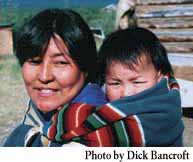
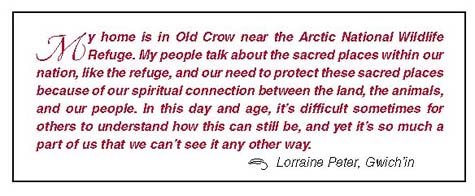
Just as the refuge's caribou�over 100,000 at post-calving time�depend on the Arctic Refuge to survive, the Gwich�in depend on the caribou for their survival. They are known as the Caribou People. The caribou provide the Gwich�in with food, clothing, shoes, shelters, medicines, blankets, sleds, tools, and more. There are many similarities between the Arctic caribou and the Great Plains buffalo. Both buffalo and caribou are migratory animals that travel in great herds. They both require large, healthy ecosystems to survive. They both define the heart of the subsistence needs and cultural way of life of the indigenous peoples who live along with them. The Gwich'in people pray that the caribou do not go the way of the buffalo.
The Threat to ANWR
No one knows for certain how much commercially-recoverable oil there is in the Arctic Refuge, however best estimates by the US Geological Survey indicate it would fuel current US consumption for less than 200 days. How do you trade that for the life of one of the largest caribou herds on Earth? Or for an aboriginal culture that has flourished for thousands of years? Or for animals from all over the world that come here to breed? The choice is irreversible.
A Future for Native Peoples and Wildlife
The Gwich�in Steering Committee was authorized by the Gwich�in Nation to educate the world about the importance of protecting The Sacred Place Where Life Begins.
The Gwich�in Steering Committee is a 501(c) 3 not-for-profit that accepts and welcomes tax-deductible contributions to help protect the Arctic Refuge:
Gwich�in Steering Committee
PO Box 70164
Fairbanks, AK 99707-0164 USA
Tel (907) 458-8264
ourarcticrefuge.org
Please help us conserve The Sacred Place Where Life Begins, the Arctic National Wildlife Refuge (ANWR), to honor the Earth and all her living creatures.
Design and printing contributed by PANGAEA, www.pangaea.org. Printed in the United States of America 2004.
Complete listing of FAMILIES OF ANWR (Source US Fish and Wildlife Service)
The Arctic National Wildlife Refuge poster is no longer available in print, but the text can be downloaded in PDF format HERE.
For more information on the Gwich'in and the Arctic National Wildlife Refuge, and to learn more about the issues, please visit the following sites:
US FISH AND WILDLIFE SERVICE
ARCTIC NATIONAL WILDLIFE REFUGE
USFWS DIGITAL LIBRARY
Conservation organizations with special emphasis on ANWR include:
DEFENDERS OF WILDLIFE and its campaign, SAVE THE ARCTIC REFUGE

Copyright © 1995-2024
PANGAEA. All rights reserved.